

Part 2. The Life That Feeds the Work

Living a life that feeds the work or Being the Egg You Want to Be
Part 1 - There's no one way to peel an egg

In 1976 Mel Gibson played Romeo in a production of Romeo and Juliet that toured Australia. I was thirteen years old, living on the outskirts of Perth, Western Australia and I was very dark. I went to see the production as a school excursion. I don’t remember much else about the day. What I remember is that Mel was beautiful — and that during the play, something quite loud and deep happened to me. I decided, then and there, that I was going to be an actor.
Mel wasn’t famous at that stage. He had only just graduated from NIDA. So it wasn’t the lure of celebrity that got me. I was a thirteen year old who had never experienced being in a play let alone seen a play, watching a young man on a stage and thinking, I believe I can do that. Or maybe, in the arrogance of youth, I even thought I could do it better. Even more powerful was a sense that I needed to do it. It looked like home.
What I found in that moment was focus. Peace. A willingness to participate in life in general with the knowledge that I could now answer the question — what do you want to do? Being an artist is vocational not occupational. I truly believe that. It is not a job. It is a calling. That matinee performance in Perth in 1976, it called.
Fortuitously, about one year after I saw Romeo and Juliet, an incredible woman, Josie Fantasia, started the Southern Youth Theatre Company. Of course I joined immediately. If Mel was the realisation, Josie — who I am eternally grateful to — was the lifeline. That’s where it began.
—
In this article, I’m reflecting on everything that came after — not the method or the technique, but the person doing the work. The craft is only half of what you are building. The other half is you — the human being who brings the craft to life. And it deserves attention. Here is what my forty years in the industry has shown me.
Know yourself.
When I was accepted into WAAPA at seventeen — I believe I may still be the youngest person accepted onto that course, though I say that as a confession rather than a boast, and Mel was only four years prior — I knew with absolute certainty that I wanted to be an actor. That was the one thing I was sure of. Everything else in life was still developing.
By the end of first year I was, honestly, a bit of a mess. Not because the training was wrong and I had already studied set design for two years, so I knew the learning environment and the creative environment. It was purely and simply the fact that what was missing was me — my inability to be honest with myself, about myself. I was seventeen, fence-sitting on almost every aspect of who I was, emotionally underdeveloped, confused about many things in my life, and presenting a version of myself to the world that had very little to do with who I actually was. The work of an actor in training is to dig deep — but you need something to dig into.
I was fortunate — truly fortunate — that the course director at the time, Aarne Neeme — a true empath — understood my situation with generosity and without judgement. He offered me the option to take a year off and rejoin the course the following year. We discussed whether I might re-enter at second year level, but I was at least mature enough to know I needed to start again from the beginning. I had almost certainly missed too much of what first year offered. So I left. I got a job in a supermarket. And I did theatre. As much theatre as possible — musicals, Greek tragedy, Australian classics, and a very strange part-time course in psychodrama. I partied. I moved out of home. I met dozens of new people. I fell in and out of love several times. I worked evenings in a bar. It was the year I needed to discover more about myself, get off the fence, and become ready for the three years that followed. I think of Aarne every time I talk to a young actor who is struggling.
Self-knowledge is not a project with a completion date. It is an organic process that continues for as long as you are alive and paying attention. What moves you. What frightens you. What you want underneath what you say you want. What you are avoiding. All of it is useful. None of it is wasted.
Knowing yourself as an actor goes deeper than knowing your type or your castable range. We need to have an honesty with ourselves that becomes the library we tap into for the work. A director needs to know themselves because whether we like it or not, we’re shaping the room—and if we’re not honest about how we see, think, and respond, we’re not guiding the work, we’re just imposing on it.
We need to know how to deal with a career that often says no. How we respond when something doesn’t work — whether we collapse, deflect, blame, or learn — tells us more about ourselves as practitioners than almost anything else.
When I was an auditioning actor, I used to give myself twenty-four hours to mourn a job I didn’t get. One day. Feel it fully, then move on. Hearing the word no is something an actor will hear across their entire career. Twenty-four hours was enough. After that, it wasn’t grief. It was at risk of being a habit. An actor who cannot survive a fail cannot take risks. And risk is the whole point.
Knowing how we respond when something does work matters just as much. This is where humility becomes a craft tool rather than a virtue. When a moment lands, when a performance clicks — the temptation is to bottle it, repeat it, rely on it. The actor who chases the same result twice has already stopped listening. The director forcing what worked in one production onto a new production is not servicing the play or the uniqueness of their cast. What worked last night was a live event between specific people in a specific room. What worked on that take was a live event between specific people in a specific moment. Neither can be replicated.
I’m not talking about improvisation here, or winging it and changing things for the sake of it — I’m talking about being in the moment. Don’t repeat it, do it again was drummed into us at WAAPA. The useful question is not how do I do it again — but why did it work. What did I do before the audition that won me the job — is it worth including in my audition-day prep? How did I nurture actors into a scene that worked for my production. Is it now part of my directorial process.
Useful discoveries deserve to be kept. But be very careful about developing tricks. A trick is a result without a cause. Audiences feel the difference before they can name it. So do directors. And definitely the camera does.
How you receive feedback in the rehearsal room matters just as much. Whether you can be redirected without taking it personally or dismissing it defensively. The actor who cannot be redirected has made their ego the most important thing in the room. The director who cannot listen to their actor is dictating. I remember watching a run of a friend’s play he had directed with students. He asked me to give them notes. At the end of the session a young actor looked very put out - upset even. When I asked what was wrong, she said — almost through tears — that I hadn’t given her any notes and she asked if she was that bad? I told her: ‘it’s because you’re doing a beautiful job.’ There’s no time in rehearsals for a director to give out all the positives. We’d be here all night.
Rejections, direction, scrutiny, listening, observations about the work — none of these are personal. They are the mechanics of getting the job done in an industry that is time poor. The sooner you understand that, the more useful you become in a room. There is a distinction worth contemplating over a coffee.
I worked with an actor whose character had an extraordinary final moment in the play. He was a little old world in his approach and wanted to play it directly to the audience. I knew it would be far more powerful as a personal reflection — interior, not exterior. He fought me tooth and nail. Not in discussion or debate. In performance. Note after note, he refused to play the scene the way I had asked him to try and in every performance, he reverted to his way. It just didn’t work. His loss, and it was noticed by others that it didn’t work.
There is a distinction I used to struggle with as a younger artist — between self-criticism and self-observation. They are not the same thing. Self-criticism judges. Self-observation notices. One is the psyche’s bad parent. The other is the nurturing parent. As an actor I needed, as we all do, the nurturing parent in the room. The bad parent only ever made me smaller. I had to learn to notice it all. Where I braced under pressure. What habits I defaulted to when I was frightened. How tension lived in me. Most actors know their instrument generally. Fewer know it with real precision. And this is a truth for directors also. I had to learn my energy and my rhythms — when I did my best work, how I recovered after a difficult rehearsal or a bad performance. The instrument needs maintenance and that maintenance is entirely personal. Nobody else can do it for you. .
As actors, knowing how to come back to yourself after a role is as important as knowing how to go in. The darker the material, the more deliberately you need to make that return. Some actors develop rituals — a physical action, a phrase, a walk around the block — that signals to the body and the mind that the character has been set down for the night. I had a simple one. I would watch myself put on my character’s costume in the mirror — I’ve come to work. I would then watch myself take it off and put my own clothes back on — the job is over. What matters is that you know how to do it, and that you do it. An actor who carries a role home every night without cooling down will eventually run out of themselves to bring to the work.
As a director, I find that moving into the post-rehearsal production meetings or chats is enough to leave the emotions of the day in the studio. And then I watch crap TV and let my subconscious do the work. And then I sleep.
Vulnerability is not something many of us understand early. As young actors, we had to learn it as a daily practice. Every time I walked into a room willing to be seen — in an audition, in a workshop, in a rehearsal — I was being vulnerable, whether I realised it or not. Experience doesn’t make that easier. It changes your relationship to it. I love Phasic Relaxation for this reason. My warm-up became one of the things that helped me find that state — being open physically and emotionally is a prerequisite for the work.
We all have to find the balance between vulnerability, nurture and protection. We are not being asked to be defenceless. We are being asked to be available. Too many people confuse vulnerability with weakness. It is the opposite. The vulnerable actor is the better actor.
Knowing how you wait for a job is also worth some scrutiny. Waiting for a gig that is satisfying — creatively or fiscally — is part of the industry and you had better get used to it.
My answer is simple: don’t wait.
If you are not officially working, do the work an actor needs to do to maintain their craft. Create. An actor acts. A director directs. A writer writes. With the advent of phone cameras, there’s no excuse for a group of buddies not to walk down a street and shoot a scene or a moment, or even just filming the street through your particular eye. Check out what is considered to be David Lynch’s first home movie — Sailing with Bushnell Keeler (1967).
The work does not begin when someone gives you permission. It begins when you decide it does. A colleague and former student of mine said only the other day that they are bored with waiting — and are planning several small productions in a studio space over the coming months. I was as proud as punch to hear it. That is the instinct worth protecting.
And then there is the question of authority — knowing whether you submit too easily or resist reflexively. Both are avoidance. The actor who cannot challenge a director’s choice when it genuinely feels wrong, and the actor who challenges every choice regardless, are both protecting something that has no business being protected in a rehearsal room. My golden rule — and I have many — is to encourage actors to say: can I try this? It is heaven to my ears. Four words that change the productivity of a room and its fun.
Knowing your triggers — what sends you into your head, what makes you perform rather than live, what derails you when the room gets difficult — comes with time. As we mature, we hopefully begin to recognise the things that do not serve us and work to eradicate the damaging ones.
—
“There’s such a blessed unrest that you feel all the time, but maybe that’s what keeps you going.” — Cate Blanchett
I am blessed with my mother’s genes for resilience. Thank goodness. She was the most resilient person I have ever met. I watched her continue through life with joy — genuine joy — regardless of what life put in front of her. I learned more about resilience from watching her than from anything I have read or been taught. Some of the most important lessons are not in the classroom. They are in the people you are fortunate enough to be close to.
As an artist, resilience has been a great friend to have. It’s easy to say: reframe challenges. It is considerably harder to do. But when you manage it — when you genuinely find a way to look at a setback and ask what it is giving you rather than what it is taking — life becomes more joyful. And so does the work. I believe in the ability to improve and adapt. One of my sayings — inherited from an older actor when I was starting out, and one I love to hear former students use — is happy accidents. The actor who cannot adapt has stopped growing. Embrace the happy accidents, in and out of the studio.
At sixty-two, I am fully aware of the ageing process. I don’t mind being the age I am — though growing old sucks and is not for the faint-hearted. It is inevitable, and you have to find the joy in it. I see it this way - Every decade that passes is another cell of the jail opening its door.
The best thing about getting older is that you stop wanting more and you start trimming back. The theorists map this arc clearly enough — exploration in childhood, identity in adolescence, building in early adulthood, and from around forty onwards, what Erikson called generativity: nurturing others, passing on what you know.
The articles I write, the students I teach, the productions I make — all of it sits in the territory of generativity.
The instrument changes with each decade too. What you lose in physical range you gain in specificity. What you lose in stamina you gain in economy. The artist who fights the ageing instrument loses. The one who works honestly with what they have discovers it has not diminished. It has become more itself.
Needless to say, look after your body. But not because the industry demands a particular shape or size — it doesn’t, and anyone who tells you otherwise is selling something. The instrument needs maintenance and the instrument is you. Stamina, flexibility, strength — these are craft concerns, not aesthetic ones. Eight shows a week or a twelve hour shoot day will tell you quickly whether you have been looking after yourself. Find a practice you actually enjoy and do it consistently. The industry needs actors of all shapes, sizes, ages and physicalities. Just be healthy.
I have always had a belly — even at my fittest. I am from the pre-six-pack generation, before that particular fashion took hold. It was never a disadvantage. If anything it was the opposite — I worked more than many who only chased the hero roles. I loved it when I was directing a Renaissance play I read an article for my research stating that - in ancient Greece and Rome, and later the Renaissance — defined, prominent noses were associated with strength, character, even nobility and that smaller noses started to become the dominant beauty ideal in the mid-20th century. Marilyn Monroe, considered by many to be the most beautiful woman in the world, would today be described as thick or plus-sized. Looks are fashion. Fashion changes. Being yourself is not fashion. It is authentic.
If you are a gym bunny, please counteract it with something more fluid. A body locked into one shape can only play one type.
And sleep. For actors and directors operating under intense physical and emotional strain — in rehearsal, on set, in the middle of a run, or working daily to get the job — sleep is as essential as diet or exercise. It is where the body repairs and the mind consolidates. A chronically tired artist has less to give. Protect your sleep the way you protect your warm-up. It is not a luxury. It is maintenance. Never use ‘I’m tired’ as an excuse to not be ready to work. It’s a frustrating thing to hear for everyone.
There are certain conditions that many actors suffer from — and in my experience it tends to be the good ones. The most common is the fear of success. You may know it as the Jonah complex. It is worth reading about. It is a tricky bugger and I don't think it is talked about enough in our industry. Success represents a shift into unknown, high-pressure territory — away from the familiar space of striving and into the exposed reality of having arrived.
Alongside it sits impostor syndrome — the quiet, nagging feeling that the good work was a fluke, that you will be revealed as a fraud who cannot sustain your own creative output. Nearly all my artist friends say the same thing when they start a new gig. “Oh oh. This is the one they’ll find out I’m a fraud.” Every time. Regardless of how many times they have proven otherwise. If that is you, you are in excellent company. It keeps you in check — it keeps you working hard. Name it when it arrives and act anyway.
Remember why you are there. You do it in honour of the text. You do it for the audience. Not for yourself. You are a professional with a job to do. The moment the work becomes about you — your fear, your reputation, your need to be seen — it has already started to shrink. Point it outward. The fear has less room when the work is bigger than you are. Hopefully heart surgeons don’t have the same problem.
Holding yourself back from the very thing you have worked toward is the greatest waste of all.
After my mother died — she was ninety-two and had lived a very full life — I went into something of a tailspin. Not into sadness but into contemplating mortality and purpose as you do in heightened times like that. One of the things I focused on intensely and intently was joy vs happiness. My conclusion, after many many days of contemplation, was that happiness is just a drug. We buy a new shirt — we are happy, but the shoirt becomes old. We fall in love — the happiness drifts into contentment and a living pattern. We score the role at an audition — the job will eventually end and become a memory. But joy — joy is something that can be incorporated into every emotion and every situation we go through. And it’s consistent. We can tackle problems with joy at the base. We can walk down the street with joy in our body. We can feel true joy for someone else’s success and our own. Joy is not a fleeting emotion. It is a state of being.
I don’t seek happiness anymore. But I certainly maintain joy. That is much more in my control.
For an artist, this distinction matters enormously. The work will not always make you happy. It will frustrate you, exhaust you, expose you, and occasionally break your heart. But if joy is at the base — if it is the ground you stand on rather than the thing you are chasing — the work remains possible through all of it. Tend the joy. It is the most important instrument you have.
—
“You’re only given a little spark of madness. You mustn’t lose it.” — Robin Williams
It is so important for us to live in the world. Our job is to represent life, so we need to actually live it. Be a sensualist — taste things, smell things, feel things. Notice what a room sounds like at three in the morning. Pay attention to how people hold their bodies when they are trying not to cry or trying to hold back a laugh. Watch strangers. Some of my best acting lessons came through the observation of and reactions with everyday people I encountered through the countless itinerant jobs I had while growing up.
Navigating humans is an awesome actor’s and director's lesson. I used to read the newspaper every morning and if a story grabbed my attention I would ask myself how I would represent it in a theatre production. I do it less these days — the world is slightly depressing and the newspaper doesn’t help — but the exercise is worth keeping. It trains the mind to move between life and form, between what happens and how you might make it mean something on a stage.
I still sit in cafés and watch people. I don’t listen to their conversations — I try to work out what their relationship is. I build a drama around them. First date, second date, break up, I’m pregnant, it’s been years since I’ve seen you — good soap opera fodder. And I listen with my body. I try and take on the physicality of the person in front of me — not as a cartoon imitation, but as precisely as I can adopt their muscular existence in the world. Their breath. How they hold their weight. Where their tension lives. What their body is saying that their words are not. It is pure Laban and Chekhov. A wonderful way to exercise the imagination and the observation muscles simultaneously.
The actor who asks questions, who listens without already planning their response, who brings genuine empathy to every encounter — that actor is already practising one of the most important skills the work requires. Presence in conversation is the same skill as presence on stage. I had to learn that. The actor and indeed the director, who only lives inside their art will eventually run out of things to say about the world, because they stopped looking at it. Theatre is not separate from life. It is life made intentional. Interested is Interesting.
I’ve always been a little jealous of the artists I know that do team sports. Meeting on a cricket or football field, the shared physical language of it, the trust built through play and competition. The closest I get is being a spectator — and even then, I’m more interested in the after match party. But I love that team sports are a perfect metaphor for an ensemble. The individual skills, the collective purpose, the way a team that genuinely trusts each other performs beyond what any of its members could achieve alone. Sound familiar?
Going to the theatre stopped being a nice pastime the minute you decided to be an artist. If something moves you, ask why. If something leaves you cold, ask why — don’t dismiss it because it didn’t land for you. Most people leave a theatre having decided whether they ‘liked’ it. The theatre and film artists job is to understand it — even when, especially when, it didn’t work. Critical debate is a skill that could be well placed in the curriculum at all levels of education across disciplines.
I remember doing a theatre workshop with a group of teenagers who were not quite fitting in with the world. I asked what they liked to do in their day. One young man proudly said he watches TV all day. He had that tone that he was expecting me to tell him it was a waste of time. I said the reverse — and I added: ask why. If you like a show or an advertisement, ask why. If you don’t, ask why. I hope I had a small part in what he went on to do — he went back to study and became a music critic.
I cook. For many reasons — because I am hungry, because it allows me to get lost in another world, and because it is sensual. Nothing gives me greater pleasure than eating something I have invented or tried for the first time, or watching others eat my food. I am no chef, and there are plenty of better home cooks than me. But I absolutely love it.
Finding something that engages your senses and is creative, away from the stage or the camera is highly recommended. Find something that will not be judged. Purely for pleasure. No audience. No result. Just the doing of it. The artist who has only one creative outlet is putting all the weight on one set of muscles. Find the other ones. Use them. And if you can cook, your buddies will love you. But let them bring the wine.
Experience other art forms. Not as a break from acting — as an extension of it. Visual art, dance, music are not separate from what we do. They are asking the same questions we are. Just in different languages.
A friend once told me that when looking at a painting, find the entry point and the exit point. I love this idea and I have applied it to theatre and scene work ever since. Stand in front of a painting and stay there. Most people glance. Very few actually look. Spend ten minutes. Then fifteen. What looked simple starts to open up — the weight of a figure, the direction of a gaze, the tension between what is in the foreground and what is behind it.
A painting does not move, yet a good one is full of action. The decisions a painter makes about what to include and what to leave out — that is the same decision a writer makes about their script, and a director makes about a stage picture, and an actor makes about a moment. The frame is not neutral. Neither is a stage or shot.
During my training we had five movement-based classes each week — Martha Graham, classical ballet, tap, Feldenkrais, Alexander technique. Classical ballet was the one that made us laugh the most — a group of actors attempting something that dancers spend a lifetime perfecting. But by the end of three years we were flexible, strong, and physically alive in ways that vocal, analytical, and psychological training alone could never have produced. I have enormous respect for dancers. The discipline is a pure metaphor for maintaining your craft. If you don’t dance daily, you can’t dance. The same is true of acting. The muscles — physical, imaginative, emotional — need daily use. For directors, dance is even more literal. Dance strips away text and asks: what remains? Weight, timing, intention, where a body is in relation to another person. Meaning does not begin in words. It begins in action. In how something is done, not what is said. Going to a dance production, especially when the stars align and I'm in the middle of rehearsals, fills my creative cup.
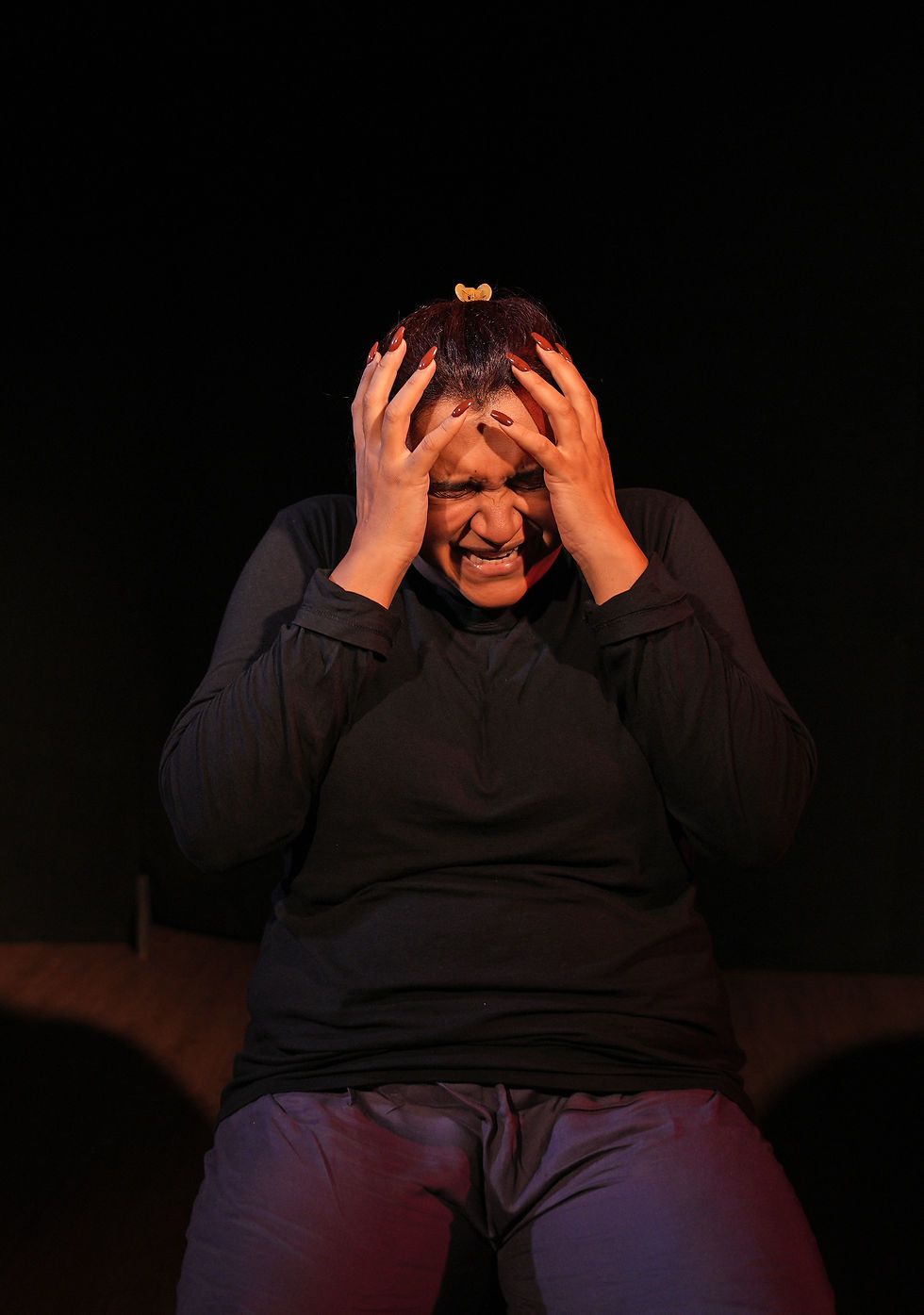
On a practical level, I was thrilled to have Choreographer Ashley Lobo and his team on board for the one-woman play A Solitary Choice by Sheoila Duncan. The work they did on the physicality of the eight or so characters Ramneeka Dhillon Lobo had to master was far beyond what we would have achieved without their input. It wasn’t dance — it was the muscularity of the characters that they perfected - the breath. That is what dance gives theatre when the two are genuinely in conversation — not decoration, not spectacle, but a physical intelligence that text alone cannot produce.
Music is closest to my heart. In another lifetime, I was a working singer, a tenor — bands, choirs, musicals. Music taught me about time. Not just tempo — phrasing, tension, release, the moment just before something resolves. Actors often rush to the next moment. Musicians live inside the one they are in. That is directly transferable to what we do on stage. The feeling of a note flowing through your body is magic. Your body teaches you where the note needs to be placed, and when it is placed correctly you feel it. And your audience feels it too. For me, the voice is music. The body knows before the mind does.
One of the best things an actor can do is join a choir. Not only to strengthen the voice but to be in an environment where you have to blend — where your individual sound must serve the collective one. A choir is a collection of people telling one story utilising many notes and phrases. Like an actor’s ensemble. The discipline of listening, of adjusting, of being in tune with the people around you — it is the same skill the rehearsal room requires.
Visual art clarifies composition. Dance clarifies action. Music clarifies time. The cross-pollination is not decorative. It is structural.
A great habit for any artist to get into is failing at something. Doing something you are not good at. That experience of being a beginner is one that many seasoned artists lose too quickly. It keeps the child alive. It reminds you what it feels like to not know — and that feeling is exactly what you need to keep you curious in the work.
Reading has been a massive part of my life, as it is with many artists. The world an artist is asked to represent is not made of scripts and theory. It is made of everything else. A novel gives you the interior life of a human being in a way no script can — the private thoughts, the contradictions, the gap between what a person says and what they feel.
That gap is the theatre and film artist's entire territory.
Poetry teaches compression and rhythm. Biography teaches you that real lives are stranger and more contradictory than any character you will be asked to play. History gives you context that is felt rather than demonstrated. Philosophy teaches you to hold two contradictory ideas at once — a capacity the rehearsal room requires constantly. For the work specifically, history and psychology are a must. History gives you the world the character inhabits. Psychology gives you the character themselves.
I stopped reading for pleasure for a while because I read so much for work. It was missed terribly. My best friend once said that books are her best friends - One of the loveliest things I have ever heard anyone say about reading. Another very dear friend of mine reads poetry like it is food — and he learns a new poem every week. Work and pleasure combining at their best. He is also in his sixties, so it helps keep the line-learning muscles active too. I can almost hear younger readers thinking it will never happen to them. Talk to me when you’re sixty.
Read widely and without agenda. The work will find what it needs.
I found my tribe gradually, over many years. People whose thoughts and opinions I trust — not because they always agree with me, but because they are honest with me. A few people whose judgement we respect is worth more than a thousand followers who don’t know us.
The tribe is not an audience. It is a mirror. It grows organically — some stay from the beginning, others fall away, others arrive later when you least expect it.
There is the tribe, and then there are friends, acquaintances, work buddies, and colleagues. These are not the same thing. Know which is which.
My true tribe is five people only. Not all of them are in the industry. These are the people I would trust to my last breath. They tell me the truth. They celebrate me. They disagree and agree with me. They mentor me and I mentor them. Completely reciprocal — which is, I think, the definition of it.
My acquaintances are many and that is joyous. My friendship circle is wide and a constant source of celebration. My work buddies are people I trust, whose company I genuinely love — and there is a particular delight when our paths cross. And then there are colleagues — the numerous people in our industry whose lives weave in and out of our own. None of these categories is lesser than another. They just ask different things of us.
A word about the cast-as-family idea. I always smile when I hear a young cast say they will be friends forever. It is youth talking, and it is beautiful — and it rarely sustains one month after closing night. Theatre creates intense, temporary intimacy. The vulnerability, the shared risk, the daily proximity — these produce feelings that are real and genuinely felt. But they are not the same as the relationships you build across a lifetime. My family is my family. My work relationships are something different — and something valuable in their own right.
Those reading this article that know me, they also know that I advocate the Friday night drink. After a weeks rehearsal, it makes complete sense to me to go out together and celebrate - us. I find that there is work that gets done in the more casual atmosphere that does not often get broached in the rehearsal room. If my expectation is to inspire an ensemble to look after each other on stage, this ritual assist my aim ten-fold.
Mentorship has been a part of my life for a very long time and I thank David Doyle, then director of DADAA WA, for sharing its value with me. The relationships I have maintained are peer mentorships — someone at approximately the same level in life, both professionally and personally. I have had two mentors at a time since the early 2000s. It is powerful and it is a blessing to have people you can bring anything to - celebration or challenge - who will listen with an empathetic ear. This is not the same as teaching. I am often asked to be someone’s mentor and what they are really looking for is a personal coach. Mentor relationships need genuine reciprocity. Seek it out. And when you are in a position to offer it genuinely — do.
—
In my final month of training we had to complete the Private Moment exercise. It was not only revealing — the process of preparing for it at home showed me how powerful a sustained focus on privacy and interiority could be. And it inspired me to focus on those times when I was alone. Not lonely — alone.
The artist who cannot sit with themselves in silence has not yet met the instrument they are trying to play. Solitude is where self-knowledge actually happens — not in the rehearsal room, but in the quiet moments when there is nothing to perform and no one to perform for. If you are always surrounded, always stimulated, always reaching for the next distraction, you won’t know what you actually think or feel. And if you don’t know what you actually think or feel, the work will always be approximate.
And I never get bored. Never. I think that is also my mother’s training. If I ever said I was bored as a child, she would send me out to weed the garden or chop wood for the water heater. Boredom was never really an option. And I am grateful for that. The artist who has learned to inhabit their own company will find it everywhere — in a quiet room, in a long flight, in the ten minutes before a rehearsal begins.
I will now risk sounding old. Don’t live on your phone. Not as a lifestyle suggestion — as a craft one. The quality of attention that an artist requires is being dismantled by the way we consume information. You cannot develop an instrument capable of genuine presence while checking notifications every four minutes. And there is something else it is taking — the capacity to daydream. I read recently that our constant access to the outside world is stopping us from daydreaming. We are never alone. That concerns me deeply.
Daydreaming is not wasted time. For an artist it is essential time. It is where the imagination wanders without agenda, where unexpected connections are made, where the work percolates without being forced. Some of the most useful things that have ever happened to my work have happened while I was doing nothing at all. Protect the nothing. It is doing more than it appears.
The most important word I ever added to my working vocabulary was why — thank you Stanislavski. Not as a performance of curiosity — as a genuine refusal to accept the surface of things. Why does this character want this? Why does this scene turn here? Why did that moment work? Every single job I have ever done has benefited from that question. It transcends any method or technique. It doesn’t belong to Stanislavski or Meisner or Chekhov. It belongs to anyone willing to ask it. The practitioner who stops asking why has started to calcify. And calcification happens faster than you think. An artist who does not ask why bores me. I say that with love — but I mean it completely.
—
“I didn’t go out looking for negative characters; I went out looking for people who have a struggle and a fight to tackle. That’s what interests me.” — Philip Seymour Hoffman
Don’t be afraid of the darker sides of character. That’s where the fun is.
During my training, it became clear — commercially, at least — that I was not going th=o be employed as the hero. At the time, my ego took a knock. But I did understand, even then, that it was giving me something valuable. The best friend, the evil uncle, the bastard son, the king — even the queen. Those were the roles I was given, and they proved a far richer education. They demanded range. Every facet of a human being had to be explored. Even now, I find heroes played without complexity less interesting than those who sit off-centre. Seek out training that takes you there — the non-heroic, the uncomfortable, the contradictory. That’s where the most compelling work lives. A very lovely actor in my batch was definitely the hero of our class but, I still believe the best work I saw him do was when he was cast - quite literally - as a character who was ugly of soul and body. After that experience, his heroes became extraordinary.
Virtue without shadow is unconvincing, just as darkness without humanity is hollow. An actor who can only access one register is only ever telling half the story. Good people do bad things and bad people do good things. Another golden rule.
Exploring the darker parts of yourself does not diminish you. It expands you — and returns you to the core of why you chose this in the first place. Not success. The work itself.
Art being art and rules are meant to be broken, one of my first professional jobs after training — an independent production of Romeo and Juliet - I was cast as Romeo. As it turned out, Mel and I had more in common than I thought.
I love to play. Not as a warm-up exercise or a rehearsal technique — as a fundamental attitude toward the work and life. The artist who plays in life — who approaches the world with curiosity, mischief, and a willingness to look foolish — brings that quality directly into the room. It cannot be manufactured on cue. It has to be lived.
Play keeps you curious. It keeps you willing to risk, which is the only way anything surprising ever happens. Our work requires vulnerability, risk-taking, and emotional honesty that often sits in direct conflict with conventional social etiquette — and that is precisely where the play lives. And nowhere is this more liberating than when you are playing a character who does things you would never do in life. Every character, no matter how reprehensible in your eyes, believes they are the hero of their own story. Find the humanity. Enjoy the investigation. An actor or director approaching Hamlet without a sense of fun within his tragic circumstance is a very dull Hamlet indeed. The moment it becomes solemn, it becomes stale.
The rehearsal room is our church and our confessional. It must welcome us to be honest, sexy, cruel, mad, beautiful, in love, in hate — everything we can tap into to get the job done, without judgement. That is the director’s job as much as anything else — to create a space that allows the actor to breathe. A room where nothing is permitted produces nothing worth watching. A room where everything is permitted, within the safety of the work, produces everything.
That sense of mischief, of genuine playful curiosity, is what keeps a performance alive night after night. Take after take. And it keeps the artist sane in an industry that can drive you mad at times. Love your life in all its glory and pain — it is the only one you have.
I trust good people much more than I trust nice people. Nice implies politeness — and sometimes the room does not need politeness. Politeness can slip into deference, into placing someone on a pedestal, into a kind of careful performance that has nothing to do with the work. Good is different. Good is loaded with empathy, playfulness, naughtiness and fun. We need that in the room. We need it in the industry. Give me good over nice every time. Nurture the joy.
Every actor knows that a character who is truly listening is one of the most powerful things you can watch on a stage or a screen. That same quality is available to us in life. Listen. Not just in the rehearsal room — to the world. And not just with your ears. Real listening is a full body activity. A favoured theory is that we listen 7% words, 38% vocal tone, 55% body language. Noticing when the atmosphere in a room changes, picking up on what someone’s body is saying before their words arrive, registering the thing that is not being said. Most people hear. Fewer actually listen. People communicate through posture, silence, pace, proximity, breath — long before language enters it. We must train ourself to receive all of it. The richer our listening, the richer our work. Exercise it every day — on stage, off stage, everywhere.
Living our life is something only we can navigate. Nobody else can do it for us and nobody else should. Hopefully we meet people along the way who make the adventure interesting — if not occasionally challenging. Even the stranger in the café whose physicality you studied for ten minutes. All of it is the life. But only we are in the driver’s seat. That has always been both the burden and the privilege of it.
—
“The most liberating thing I did early on was to free myself from any concern with my looks as they pertained to my work.” — Meryl Streep
The actors I have watched grow into extraordinary practitioners were not the ones who arrived with the most talent or the clearest method. They were the ones who stayed curious. Who kept asking why. Who lived in the world with their eyes open and brought what they found back into the room. They are the ones who turn up on time. they have done their homework. They are good to work with.
None of what I have written here is a rule. To paraphrase Declan Donnellan and Robert Benedetti, and I’m sure many others — these are keys, useful for opening certain doors, useless for others. The day any of this becomes doctrine is the day it stops serving you. Take what works. Leave the rest. And if you find something better — use it.
Ambition requires the industry’s cooperation. Passion does not. The egg doesn’t need anyone’s permission to become what it is. Neither do you.
If you missed it, check out Part One - There's No One Way to Peel an Egg.
Next up- Making a Life of It.
A note from the author: the ideas, arguments, and experiences in this article are entirely my own — drawn from forty years of working in theatre, film, and actor training. I used AI tools during the writing process to assist with spelling, grammar, and the verification of facts. What it cannot do — and did not do — is think for me, feel for me, or replace the professional experience from which every observation in this article comes.


Comments