


Glenn Hayden's popular performance-based workshop will return in 2027
Actor in the Play is a 10-weekend intensive led by Australian theatre director Glenn Hayden that immerses actors in the full rehearsal room experience.
Participants explore and refine their craft through five commissioned short plays, culminating in a public theatre season.
More than a performance workshop, it’s a comprehensive training program where Glenn focuses on developing the “actor at work,” enabling participants to deepen both their craft and practical performance skills
OVERVIEW
From the first weekend, you are in the work — training in the morning, rehearsing in the afternoon, building toward a public season.
Actor in the Play is a 10-weekend intensive that puts you inside a full production process from day one, where craft development and production work are inseparable. What you work on in the morning, you apply in the afternoon.
Five new plays are commissioned specifically for the program. AITP culminates in a 4-show public theatre season attended by industry guests.
Why choose AITP?
Is this right for me at my level?
AITP welcomes actors at every stage — from those just starting out to experienced professionals returning to the room. What matters is not where you are but how you work. The program is demanding. It rewards commitment.
What prior experience do I need?
Some basic acting training is helpful but not essential. A willingness to work consistently, collaborate genuinely, and give yourself fully to the rehearsal process matters far more than a list of credits or courses. If you're ready to work, you're ready for AITP.
Will this make me more employable?
AITP develops the qualities that professional directors and casting directors are looking for in the room — reliability, efficiency, precision, and the ability to collaborate.
Curriculum
This is a progressive, rehearsal-based training program for actors at any stage of their development.
The work focuses on practical application.
All training is applied directly in scene work, rehearsal, and performance.
THE CURRICULUM Acting technique Work with action, intention, and impulse in scene work so that behaviour is truthful, physically connected, and repeatable under performance conditions. Text analysis Score scripts using units, beats, objectives, and playable actions. Identify the target — where attention goes in a scene — and build choices that are active, specific, and usable in rehearsal. Movement Develop awareness, control, and expressive range in the body, using various movement methodologies including Viewpoints, Feldenkrais, and Alexander Technique, Laban and Grotowski. Build physical specificity for character and train responsiveness in space and in relation to other actors. Voice development Train breath, resonance, articulation, and modulation. Connect voice to text and character so language is clear, embodied, and sustainable across a performance season. Breath, action & emotion Connect breath with impulse and physical action. Work with emotional life as behaviour rather than feeling — grounded in the body, responsive to the other actor, and free from tension. Stagecraft Work with blocking, spatial relationships, props, and the practical demands of the performance space so that movement is purposeful and the actor is in control of the stage. Rehearsal technique Develop the skills of the actor in the room — receiving and applying direction, adjusting choices between runs, staying present in the process, and building work that improves through repetition. Etiquette Build the professional habits of the rehearsal room — punctuality, preparation, focus, and the ability to work consistently and respectfully with others. Performance Apply the work in a full rehearsal process culminating in a public theatre season. Learn to make the transition from rehearsal to performance — adjusting to the presence of an audience while holding the integrity of the work. Sustaining the work Develop the techniques for holding performance across a run
Why I developed AITP
Glenn Hayden
I have spent forty years in rehearsal rooms. I keep seeing a problem among emerging artists: actors who are trained, who know the methodology, who can talk about objectives and actions and impulse — but who fall apart the moment they are in a room with other actors, under pressure, with a director giving notes and a performance date on the wall.
The training hasn't failed them. It just hasn't been tested in an environment that is not about being evaluated. There is a difference between knowing a technique and owning it — and you only own it by using it, repeatedly, in conditions that demand something real from you.
The work never stops. That is true for every actor, regardless of experience.
AITP was built to close that gap. The rehearsal room is the playground for the actor's homework. Everything you learn here gets used here — on text, with partners, in a working ensemble, building toward a season of public performances.
This is not general training. It is specific, demanding, and grounded in professional practice. If you are ready to work, it will show you what you are capable of.

What will I learn?
You will both develop and apply the actor's craft in a practical, rehearsal-based environment, informed by Glenn Hayden's 40 years of professional theatre practice, grounded in his conservatoire training at the Western Australian Academy of Performing Arts.
You will learn to:
Work inside a rehearsal Rehearse a play, take direction, and adjust quickly. Work within an ensemble Listen, respond, and collaborate effectively and empathetically. Work from text Break down scripts and translate analysis into playable choices. Train voice and body Develop breath, resonance, articulation, and physical range — applied to text and character. Build character through doing Apply technique to build character inside the rehearsal of the play — not in isolation. Apply technique under pressure Use established approaches — integrated into rehearsal, not taught in isolation. Responsibility to the play Understand your responsibility to the text, the production, and the ensemble — before you enter the room. Operate as a professional Bring punctuality, preparation, and focus to every session. Sustain and perform Hold the work across a public season with clarity and consistency.
Extend your craft and make new discoveries in a safe and challenging room

What Differentiates AITP?
The rehearsal room is where preparation meets practice. AITP is built around that meeting point.
Training happens inside a continuous rehearsal process — on text, with partners, under the real conditions of making a production. Technique is tested the moment it is learned. That is what makes it stick.
You are not working alongside other actors — you are working with them. The room demands preparation, presence, and responsibility. When every actor in the room brings that, something happens that no exercise can manufacture.
AITP commissions 5 Indian playwrights each year. Participants have the honour of performing these plays in their premiere production, making AITP a perfect synthesis of training, practice, performance.
The better prepared you are, the more freely you can play. You don't practise for the real thing...
This is the real thing.
Outcome
Theatre performance
Four performances in a professional environment, open to the public. Stage and screen directors, casting directors, and your peers are invited to a special industry performance as your guests.
Video
Every graduating participant receives a video of the performance to use as part of their showreel and to share with those unable to attend.
Andrew Lewis
ACTOR / ASSOCIATE PROFESSOR WAAPA/EDITH COWAN UNIVERSITY
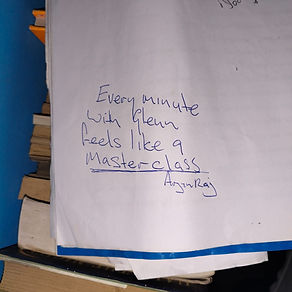
It is my strong opinion that Glenn is one of the top talents to come out of WA.
The Artists

Glenn Hayden
Program Director
Glenn Hayden created Actor in the Play in Mumbai, India, in 2018. Glenn is an award-winning Australian theatre director and educator with over four decades of experience across Australia, India, and internationally. A graduate of the Western Australian Academy of Performing Arts, he has led more than sixty productions, served as artistic director of festivals and major events, and has commissioned over forty new works. He is the recipient of the Emotions Scientist Award (2025) from Andhra University’s Dean Van Leuven Peace Studies and Action Centres, recognising exceptional work in social and emotional intelligence. His work spans theatre-making and actor training, with a focus on ensemble, discipline, and the relationship between actor and text.

Asif Ali Beg
Guest Voice Specialist
Asif Ali Beg trained at East 15 Acting School, University of Essex, on a British Council Charles Wallace scholarship. His dubbing work spans decades of major animation — Frozen, The Incredibles, Ice Age, Madagascar, and more than fifty further productions for Disney, Netflix, and Cartoon Network — and earned him the AVA Award for most innovative use of voice talent. A practising trainer in voice and speech, he has taught at Drama School Mumbai and Whistling Woods Film School, and works widely across theatre and the corporate sector. Glenn has collaborated with Asif across multiple productions.
The Writers - 2027
Each year, Actor in the Play commissions five local playwrights to create original works, giving participants the unique opportunity to bring new Indian plays to life while collaborating with some of the country’s most exciting writers and theatre makers.

TBA

TBA
TBA
TBA
TBA


