

For the Love of Warm-Ups

“We do not rise to the level of our expectations; we fall to the level of our training.” Anon
Opening Reflection
I always loved warm-ups as an actor, and now as a director, I love even more watching actors get ready for their day’s work or a performance. There’s something about that quiet, focused time before rehearsal begins—the way bodies wake up, voices open, and minds settle into the work. The actor ‘arrives into the working space’. It is a wonderful ritual of our work and for me, quite spiritual in its nature. Warm-ups aren’t some tedious obligation; they’re the preparation that lets you step onto the stage fully present, confident, and energised.
It’s not just about stretching muscles or warming the voice. Warm-ups are a way for actors to find their balance, tune into themselves, and connect to each other and importantly, the stage or space they are about to open up in…..the church. They’re the bridge between the world outside and the work of the moment, a chance to leave distractions behind and enter the creative space with attention and clarity. In this sense, it reflects one of my favourite sayings at work; ‘leave your shit at the door’.
"Preparation is the key to freedom on stage." — Stella Adler
The idea of this post led me to looking at how warm-ups have been valued throughout history, across cultures and centuries, as a central part of the actor’s craft.
Warm-Ups Through History
Actors in ancient Greece performed in vast open-air theatres before audiences of thousands. With no microphones or amplification, they relied entirely on breath, voice, physicality and the acoustics of stone. Stepping into such a space demanded preparation.
Actor warm-ups are far from a modern invention. For well over two thousand years, performers have understood that stepping onto a stage requires preparation—physical, vocal, and mental. Warm-ups were never arbitrary; they were often ritualised acts designed to awaken the instrument, focus the mind, and align the ensemble before performance began.
In ancient Greece, actors combined breath work, chanting, and deliberate gestures to project their voices, focus attention, and unify the chorus. These practices helped performers transition from everyday life into the heightened reality of the stage. Theatres such as the Theatre of Epidaurus—which could seat between 12,000 and 14,000 spectators—demanded disciplined preparation. Daily warm-ups strengthened breath control, resonance, and clear diction, ensuring that even audiences in the back rows could hear every word.
Across other performance traditions, similar practices developed in different forms. In ancient India, performers used precise vocalisations, rhythmic breathing, and bodily postures to align energy, control, and spirit for storytelling. Traditional Chinese opera combined stretching, vocal exercises, and martial-arts-inspired movement to cultivate flexibility, breath control, and stage presence. In Japan, performers working in Noh and Kabuki traditions practised repetitive footwork, stretching, and vocal exercises to develop mindfulness, precision, and presence within highly codified forms.
Although the styles vary, the underlying principle remains strikingly consistent. Effective preparation integrates body, voice, and mind, allowing the performer to arrive physically and mentally ready for the work. It is a principle that has endured across cultures and centuries—and one that continues to inform modern actor training today.

“Before you can create art, you must prepare the instrument that creates it.” — Jacques Lecoq
Arriving Prepared
It's important to consider the simple but powerful act of arriving early to work to do a warm up. It's amazing how this can affect your working day. In my recent production of Romeo and Juliet, a few actors consistently came ahead of call time. The difference was noticeable—they were grounded, focused, and fully ready to begin. (A ten-fold requirement for tackling Shakespeare.) Their bodies and voices were already active, which meant rehearsal could start immediately without hesitation.
Of course, early arrival isn’t always possible due to studio or venue scheduling, but it’s worth asking the director if the ensemble can have the first half-hour to prepare. If that time is granted, it must be used intentionally—it’s preparation, not time for a second cup of coffee.
Some directors do provide independent warm-up time, while others lead a guided group warm-up, especially in large ensembles. I often do this myself - especially with larger casts. A shared warm-up can bring a company together, aligning energy, focus, and spatial awareness. It reinforces a simple truth: every performer, regardless of role size, contributes to the ensemble’s rhythm and storytelling.
It’s lovely when you find an actor in the ensemble whose warm-up resonates with your own. Shared routines, often emerging from a common training background, create an unspoken language. Familiar rhythms and exercises energise both actors, sharpen focus, and support the collective responsiveness that is essential for rehearsal and performance. I relish those occasions where a group of actors know the difference between the NIDA Hand-Shake and the WAAPA Chin-Wobble (I must admit, I teach both even though I’m a WAAPA Grad).
Psychological and Emotional Preparation
Warm-ups prepare more than the body and voice—they ready the mind. They act as a transition from the outside world into the imaginative, collaborative space of rehearsal. The body becomes responsive, the breath deepens, the voice opens, and the mind sharpens. Thoughtful warm-ups serve both practical and psychological purposes, helping actors arrive fully present, mindful, and attentive to their work and fellow performers.
“The actor must learn to be in a state of relaxed concentration.” — Konstantin Stanislavski
Responsibility of Training Institutions
Within formal training, actors’ approaches to warm-ups vary widely, which highlights the responsibility of schools and teachers. Institutions must equip students with a toolbox of exercises they can draw upon throughout their careers. The goal isn’t to prescribe a single “correct” routine, but to ensure graduates leave with the knowledge and skills to adapt, refine, and make routines their own.
I was teaching a class at an actor’s studio not so long ago, and I asked the senior students to demonstrate their warm-ups. The variety was messy—and mostly not productive. Most wandered around, flapping their arms without structure or focus. One student sat in a corner with earphones on, eyes closed, swaying to the music. When I asked what he was doing, he replied - “I’m warming up.” I wanted to scream! Not at the actor, but at the teachers of the school. Warm-ups are deeply personal, but their effectiveness depends on intention, guidance, and knowledge—a responsibility that falls on teachers and schools to provide.
Warm-Ups Across Performance Styles
There’s often a misconception that some performance platforms—film, for example, or ultra-naturalistic acting—do not require warm-ups. I beg to differ. Whether preparing for contemporary naturalism, heightened text, physical theatre, musical theatre, or film, warm-ups remain crucial. The exercises may differ in emphasis, but the underlying purpose is the same: readying the body, voice, and mind. Actors must be able to move freely, speak clearly, and respond emotionally—regardless of genre. Structured warm-ups support exploration in rehearsal, precision in performance, and sustained energy across all styles of work.
Of all the performing arts, the practitioners I admire most in this regard are dancers. Quite literally, if a dancer does not warm their body, they cannot dance. It is understood as an absolute necessity. So why would an actor think any differently? After all, the actor’s instrument is also the body—along with the breath, the voice, and the imagination that animates them.
Even Masters Prepare
Experienced performers can sometimes underestimate the value of warming up. They can assume that skill or familiarity with the material will carry them through. But skipping preparation gradually reduces body awareness, flexibility, vocal resilience, and the ability to explore a full range of expressive choices. Warm-ups are not a beginner’s habit; they are a professional commitment to maintaining the instrument and sustaining one’s creative range.
I remember, as a young actor, rehearsing a play upstairs at His Majesty’s Theatre in Perth while a touring production starring Maggie Smith was performing a matinee downstairs in the theatre. On my way up, I took a shortcut through the wings of the theatre. In a quiet corner of the darkened stage I noticed a figure sitting upright, spine aligned, calmly and privately working through her vocal exercises: “P-P Pipetty P.” Yes, it was Dame Maggie. I doubt there are many actors who can claim they don’t need to warm up if the great Dame herself still saw fit to do so.
Modern Actor Training Perspectives
Directors and teachers across the twentieth century and beyond placed enormous value on readiness:
Konstantin Stanislavski: Relaxation, breath awareness, freedom of movement.
Jerzy Grotowski: Intense physical preparedness and ensemble awareness.
Peter Brook: Stripping away distraction so the actor arrives fully present.
Jacques Lecoq: Awakening the expressive body through movement pedagogy.
Anne Bogart: Ensemble training emphasising alertness, listening, and presence.
Stella Adler, Uta Hagen, Michael Chekhov: Daily rituals integrating imagination, movement, and breath.
Voice pedagogues: Kristin Linklater, Cicely Berry, Patsy Rodenburg—freedom, resonance, articulation.
Reading their work, it becomes clear that readiness sits at the centre of actor training. No matter the method or style, the principle remains: the performer must arrive prepared. Warm-ups remain one of the simplest and most reliable ways to continue that tradition today.
I had the extraordinary fortune of having Annie Stainer as our physical theatre trainer at WAAPA. Annie was an English mime, clown, and physical theatre artist whose teaching always centred the body as the foundation of performance. Annie led movement training at the Western Australian Academy of Performing Arts (WAAPA) before founding Total Theatre in Perth. Annie’s philosophy was simple but profound: to step into rehearsal or performance fully present, actors must engage their entire bodies and expressive instincts, cultivating ensemble awareness, physical intelligence, and a sense of playful connection. Watching her teach was a lesson in how preparation itself can become an art. Annie also worked extensively with David Bowie. Yes, David Bowie! She appeared with him both on film and on stage in 1972 during his Ziggy Stardust era. She is the inspiration referenced in the opening line of John, I'm Only Dancing (“Well, Annie’s pretty neat…”).
“The actor’s instrument is not only the voice and body, but the imagination.” — Michael Chekhov
Personalizing Your Routine
A warm-up is ultimately personal. Full-time training gives actors time to develop a routine aligned with their practice over time, but self-taught actors or those attending various workshops must research and experiment to find what works. Warm-ups are a selfish act, in the best sense—you know your body and mind better than anyone, so you must design routines that address the areas needing attention, activation, or focus.
This personalisation naturally transitions into a practical, fully structured warm-up that combines all the principles discussed.
“No two actors prepare in exactly the same way.” — Cicely Berry
Keeping your Instrument Ready
A warm-up is valuable not only on rehearsal or performance days, but as part of an actor’s everyday practice. Regularly waking up the body, breath, and voice keeps the instrument responsive and prevents the stiffness and vocal fatigue that can accumulate through daily life. I’m not talking about going to the gym or building fitness for its own sake, but about maintaining the actor’s instrument—keeping breath active, the body released, and the voice available. Just as musicians practise scales or dancers take a class, actors benefit from a simple daily routine that keeps them physically and vocally responsive. In this sense, a warm-up is less about preparing for a specific performance and more about living in a state of readiness—keeping the body, mind, and voice performance-ready whenever the work calls.
“The actor must train as rigorously as the dancer and the athlete.” — Jerzy Grotowski
The Power of the Ensemble Warm-Up
Too often, I’ve skipped the ensemble warm-up before a performance in the rush of the moment — and I always kick myself for it. Warming up together gives performers a shared moment to breathe, move, and focus before the work begins. As the group aligns its energy, it settles into a collective rhythm, building listening, awareness, and trust—the very heart of strong ensemble work. By starting the work together in warmup, the cast enters rehearsal or performance more connected, present, and ready to support one another on stage.
One of my favourites is the “Pass the Clap” exercise. It’s the very least an ensemble can do together, yet it sets a clear, energising tone: maintain eye contact and adopt the simple mantra of “come to work.” Deceptively simple, it instantly focuses the group and reinforces connection.
Another exercise I cherish is “Permission.” My god, how many times I’ve seen an overconfident actor humbled by this exercise—then truly connect with the team and discover the joy in happy accidents—is uplifting every single time.
Ensemble warm-ups become far more powerful when the group takes ownership of the process. I often ask ensembles to pick a few exercises they genuinely enjoy and make them part of their pre-show routine. When they do, the warm-up becomes a symbol of their shared ownership of the story they’re about to tell. And if a director doesn’t organise this, don’t wait—take the initiative yourself. Set up a few simple exercises, and your cast will thank you for it.
Plan thoroughly and act with preparation; success follows the diligent and the careful. - Chanakya, Arthashastra
The Danger of Warming Up Too Early
Warming up too early can be just as damaging as skipping it altogether. I’ve seen it happen—actors finish a warm-up, step away, and by the time they hit rehearsal or the stage, focus drifts, muscles cool, and the energy they worked to build has faded. Keep the gap between finishing exercises and stepping on stage as short as possible, and make your warm-up a distinctive stage of your pre-show or rehearsal schedule. This way, the ensemble enters the work present, alive, and fully engaged, instead of having to reignite energy that’s already slipped away.
Warm-Ups Are Not Line Runs
Warm-up time is not the moment to stand around with a script in hand and simply run lines. By all means, line work can accompany a warm-up, but if all you do is stand still reciting text before preparing your body and voice, it often becomes a surprising waste of time. A good warm-up prepares both body and mind, so when lines are spoken they land with more clarity, energy, and connection. In my experience, running lines during or immediately after parts of a warm-up is far more fruitful. The key is learning which exercises need your full mental focus and which ones can happily coexist with line work. Some moments demand total attention, while others actually benefit from the gentle distraction of speaking text as the body loosens and wakes up. Part of the craft is learning the difference.
Victorious warriors win first and then go to war, while defeated warriors go to war first and then seek to win. - The Art of War by Sun Tzu
30-Minute Actor Warm-Up Routine
Below is a template for a thorough 30-minute (approximately) warm-up. Many of you will have your own exercises to substitute for what I’ve suggested, but for some this may offer a practical starting point.
My hope is simply that actors remember how essential the warm-up is: it prepares the body, breath, and voice to work freely and with focus, and.......it's a great way to start your day!
1. Body Wake-Up and Stretch (8–10 minutes)
Actors use their whole body when performing. This stage wakes up muscles, releases tension, and brings energy into the body.
Dynamic Wake-Up (3–5 minutes)
Light Jog on the Spot:
Jog gently in place.
Keep shoulders relaxed, arms swing naturally.
Breathe easily, gradually increasing energy.
Bounce:
Bounce lightly through the knees.
Stay loose and relaxed.
Eight-Count Shake:
Shake each body part to release tension.
Sequence: Right hand → Left hand → Right arm → Left arm → Right leg → Left leg → Bum → Whole body.
Counts: 8 times each → 4 times each → 2 times each → 1 times each
Phasic Relaxation (Progressive Muscle Relaxation)
Sit or lie comfortably, feet grounded if seated, hands resting gently.
Close eyes or soften gaze.
Take two slow breaths.
Breathing Pattern:
Inhale 4 seconds → Pause briefly → Exhale slowly 6 seconds
Muscle Sequence (Tighten and Release Slowly with each breath):
Hands – Clench fists - release
Arms – Flex biceps - release
Shoulders – Lift toward ears - release
Face – Scrunch forehead, eyes, jaw gently - release
Chest – Deep inhalation hold - release
Stomach – Tighten abdominal muscles - release
Glutes – Squeeze - release
Thighs – Tighten - release
Calves – Lift toes upward - release
Feet – Curl toes downward - release
Finish: Three slow breaths, gentle wiggling of fingers and toes, open eyes slowly.
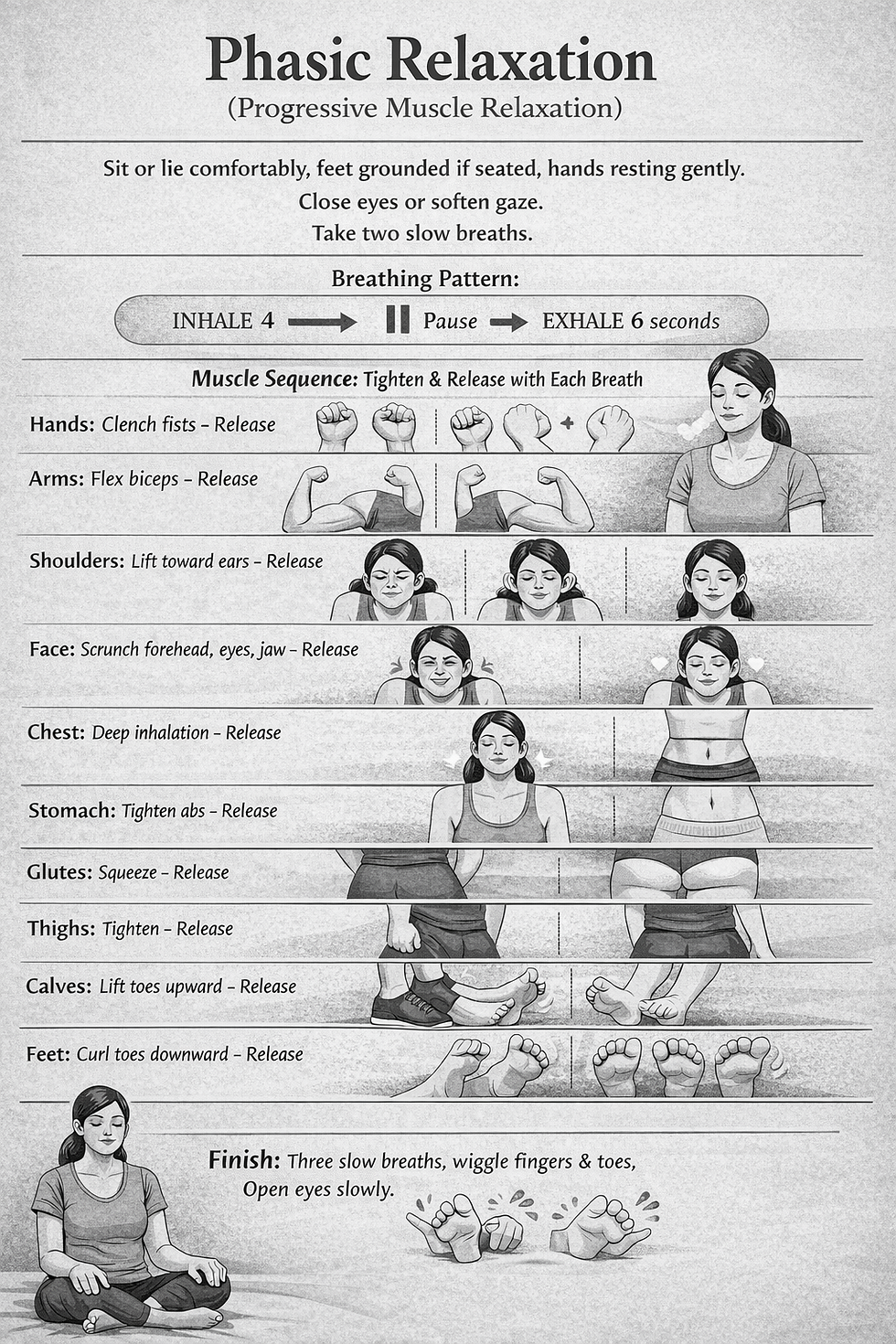
Phasic relaxation helps reduce tension, improve body awareness, and support vocal clarity.
2. Breath and Grounding (3–5 minutes)
Good breath control supports voice, focus, and stage presence.
Stand neutral - soft knees above ankles, hips above knees, shoulders above hips, long spine, shoulders relaxed, head floating above.
Breathing Exercise:
Inhale through the nose 4 seconds, ribs and belly expand.
Exhale slowly 6–8 seconds, allowing the body to soften.
Breath Pulses:
Add gentle pulses on the exhale: “ha, ha, ha” or “ff, ff, ff” or he, he, he
These wake up the diaphragm and connect breath to sound.
Importance: Breath work supports vocal power, focus, and presence on stage.
3. Vocal Warm-Up (10–12 minutes)
A warmed-up voice allows exploration of pitch, volume, and emotion without strain.
Humming & Sirens (3–4 minutes):
Closed-mouth humming: feel vibration in lips and face. Massage the face while humming. Especially find that hinge that joins the jaw to the skull and massage well.
Lip trills: “brrrr” to release tension.
Sirens: slide smoothly from low to high pitch and back on one controlled breath.
Open Vowel Work (3–4 minutes):
Slide gently through: Mee → Moh → Maw → Mah→ May → Mee
Optionally move slightly up and down in pitch
Develops resonance, tone, and vocal flexibility
Pitch and Speech (3–4 minutes):
Use everyday phrases:
“Good morning”
“Thank you very much”
“How are you today?”
Explore different pitches: low, medium, high
Explore volumes: quiet, medium, strong
Improves vocal adaptability for characters, emotions, and stage dynamics
“No art can be accomplished without practice.” - Nāṭyaśāstra
4. Articulation and Text (5 minutes)
Clear articulation ensures the audience hears and understands every word.
Tongue Twisters (2–3 minutes):
Red leather, yellow leather
Unique New York
Big black bug
Blue blue blue glue
Good blood, bad blood
Fresh fried fish
Crisp crusts
Thin sticks, thick bricks
Selfish shellfish
Greek grapes
Red lorry, yellow lorry
Lesser leather never weathered wetter weather better
Focus on consonant articulation, tongue agility, and rhythm. No need to use all of them in one session.
Short Text Practice (2–3 minutes):
Choose a short piece: poem, monologue lines, or script excerpt
Steps:
Hum the rhythm first
Speak slowly with clear articulation
Focus on breath and flow
Run the text using only consonants
Run the text using only vowels
Put them together
Explore emotion, pitch, and volume
Repeat as needed
Importance:
Text work integrates breath, voice, and emotion, preparing actors to respond instantly and convincingly in rehearsal or performance.
A golden rule is consonants are information and vowels are emotion.
Finishing Moment
30–60 seconds of quiet standing or gentle breathing
Notice how your body and voice feel
Overall Purpose:
Activates body, breath, voice, and ensemble awareness
Primes mental focus, reduces tension
Prepares actors for both rehearsal and performance
Regular practice builds stamina, resilience, and expressive freedom, supporting a lifelong commitment to maintaining your instrument
“Practice is the best of all instructors.” - Marcus Fabius Quintilianus
A note on the spinal roll
If a spinal roll is something you utilise in your warm-ups, I beg you to remember two things:
It is NOT a stretch so soften your knees if you feel a pull. The exercise is about releasing the spine, one vertebrae at a time
This is the most important thing: The head leads the roll down and the head is the last thing to roll up. Our heads are the heaviest part of our body so let it lead the way. Carrying tension in your neck by not releasing the head into its full weight puts an enormous amount of strain on the lower and upper spine.
Bonus Material
Tongue Twister Warm-Up
Repeat each twister five times.
Stage 1: Gentle Articulation (Warm-Up & Awareness)
Unique New York
Red leather, yellow leather
Blue blue blue glue
Greek grapes
Try tying twine round three tree twigs
Focus: Slow repetition, clear consonants, relaxed jaw. No speed yet—just awareness and accuracy.
Stage 2: Moderate Challenge (Breath & Consonant Control)
Big black bug
Crisp crusts
Selfish shellfish
Red lorry, yellow lorry
Lesser leather never weathered wetter weather better
Focus: Keep articulation precise under slightly faster pace. Breathe naturally between repetitions.
Stage 3: Complex Sequences (Speed & Coordination)
Fresh fried fish
Thin sticks, thick bricks
The sixth sheik’s sixth sheep’s sick
“Are they copper bottoming it, my man?” “No ma’am, they are aluminium-ing it!”
She sells seashells by the seashore
Focus: Increase speed gradually, maintain clarity, engage the diaphragm.
Stage 4: Advanced & Playful (Mental Focus & Performance Energy)
Peter Piper picked a peck of pickled peppers
How much wood would a woodchuck chuck if a woodchuck could chuck wood?
Fuzzy Wuzzy was a bear, Fuzzy Wuzzy had no hair, Fuzzy Wuzzy wasn’t very fuzzy, was he?
I saw Susie sitting in a shoeshine shop
Repeat any previous tongue twister at full speed while adding expressive gestures or character tone
Focus: Combine clarity, speed, and theatricality. Challenge memory, breath, and vocal stamina.
Tarantella
by Hilaire Belloc
The Tarantella by Hilaire Belloc is a playful, rhythmic poem that wakes up the body, breath, and voice all at once. Its lively sounds, shifting emotions, and tongue-twisting phrases help actors improve articulation, breath control, focus, and ensemble awareness—while keeping warm-ups fun and engaging.
Movement Suggestion: Recite the poem while incorporating small, energetic movements—tapping feet, swaying, or light stepping—to mirror the rhythm and pace of the words. This helps connect breath, voice, and body, making the warm-up both vocal and physical.
Do you remember an Inn,
Miranda?
Do you remember an Inn?
And the tedding and the spreading
Of the straw for a bedding,
And the fleas that tease in the High Pyrenees,
And the wine that tasted of the tar?
And the cheers and the jeers of the young muleteers
(Under the vine of the dark verandah)?
The complete poem is here: https://writing.upenn.edu/library/Belloc-Hilaire_Tarantella.html

About Glenn
Glenn has been working in the performing arts industry for 40 plus years. A graduate of the WA Academy of performing Arts, he worked as an actor for 10 years until he discovered his love of Directing. Glenn has directed over 60 professional projects, has been Artistic Direrctor of companies and festivals and has been activeley involved in the development of the performing arts industry.
Glenn has a great passion for teaching and mentoring emerging artists.


This goes straight in my prep folder. Thank you so very much!
These are absolutely golden techniques and get the actor “on” right away. I found this article super informative, a gentle but important reminder of the true power of the daily routine of the actor! Thank you and please share more!
Glenn...sharing your observations and experiences enriches an artist.
It was a pleasure to read your article.
Many thanks...from me and the Theatre fraternity...not many take pains to write.🙏
So well articulated! 💗 thank you for sharing
This is a beautiful read and every actors go to handbook
Thank you for penning it down Glenn Hayden 🤗